
Reviewed · PAMUKKALE & HIERAPOLIS TRIPS
Fethiye: Pamukkale Hot Spring & Hierapolis Small-Group Tour
Cotton terraces meet Roman ruins in one day. This full-day tour from Fethiye mixes natural wonder at Pamukkale with the major Hierapolis archaeological site, guided by lively pros like Yalcin. If you like seeing famous places with real context (not just selfies), this kind of structured day can feel just right.
I love the chance to walk around the travertine terraces and hot pools area, because the mineral textures look different up close than they do in photos. I also like how the day gives you time to take in big set pieces like the Roman amphitheater and connect them to what you’re seeing on the ground.
One practical consideration: Cleopatra’s Pool is temporarily closed for renovations, so the pool access isn’t available right now. Entrance fees for Pamukkale & Hierapolis are also not included (30 EUR), so plan for that extra cost.
In This Review
- Key tour highlights at a glance
- A 12-Hour Fethiye to Pamukkale Power Day (Comfort Matters)
- Pamukkale Cotton Castles: Why the Travertine Terraces Are So Special
- Hot Springs and the Cleopatra’s Pool Reality Check
- Hierapolis Ruins: Amphitheater Views and the Turkish Bath Museum
- Necropolis of Anatolia: Sarcophagi, Including a Marcus Aurelius Name
- Guided by Yalcin and Friends: How the Liveliest Part of the Day Works
- Lunch, Breaks, and Timing: Making a Long Day Feel Reasonable
- Price and Value: Is $74 Worth It Plus the 30 EUR Tickets?
- Who Should Book This Tour (and Who Might Skip It)
- Should You Book This Fethiye to Pamukkale and Hierapolis Tour?
- FAQ
- How long is the Fethiye to Pamukkale and Hierapolis tour?
- Where do you get picked up?
- What’s included in the tour price?
- Are entrance fees included for Pamukkale and Hierapolis?
- Is Cleopatra’s Pool available during the tour?
- Do I need swimwear?
- What language is the guide available in?
- Is it a long drive from Fethiye to Pamukkale?
Key tour highlights at a glance
- Air-conditioned hotel pickup in Fethiye plus a long but comfortable coach ride to Pamukkale
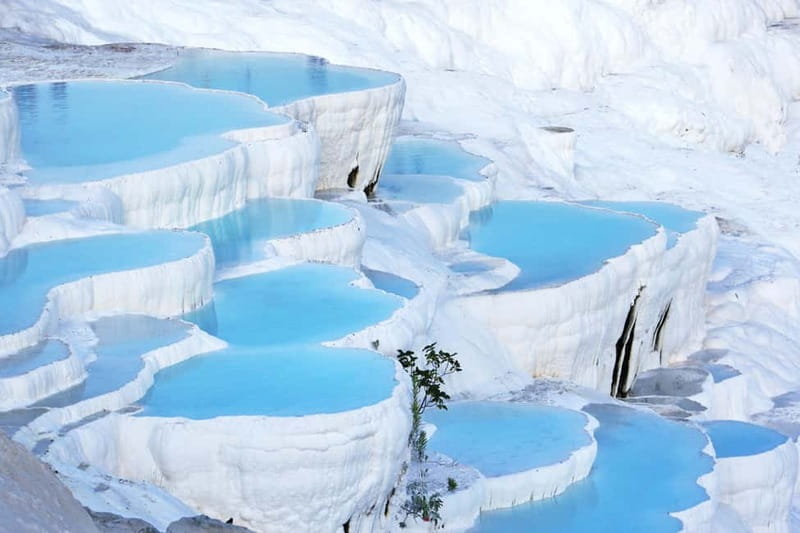
- Pamukkale travertine terraces with clear-water pools, hot springs, and dramatic mineral formations
- Hierapolis ruins including the Roman amphitheater and the former Turkish Bath museum
- Cleopatra’s Pool area timing matters, since it’s currently closed for renovations
- Necropolis of Anatolia with sarcophagi, including one tied to Marcus Aurelius Ammianos
- Optional gemstone factory stop if the schedule has room
A 12-Hour Fethiye to Pamukkale Power Day (Comfort Matters)
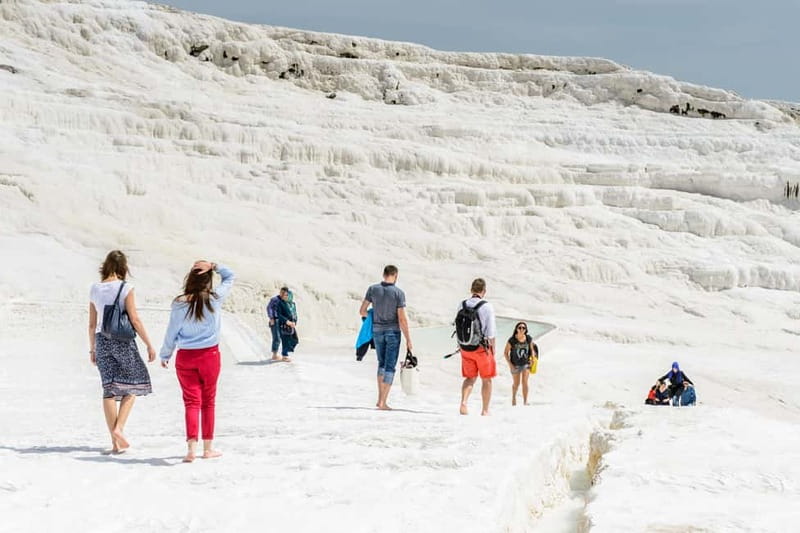
This tour is built for people who want two bucket-list sites in one day: Pamukkale plus Hierapolis. The tradeoff is time. It’s about a 200 km drive each way, and the overall duration is 12 hours, so you need to treat it like a full-day outing, not a quick detour.
The good news is the ride is in an air-conditioned bus with hotel pickup and drop-off in Fethiye. In hot Turkish summers, the A/C is not a small detail, it’s the difference between arriving fresh enough to enjoy the sites and arriving drained. Also, the day includes breaks on the way, which helps you reset before you step into sun and walking.
If you’re the type who likes organized pacing, a small-group setup plus a live guide is a big plus. You’ll still get moments to explore on your own, but the guide keeps you moving through the must-see zones so you don’t waste your energy trying to figure things out.
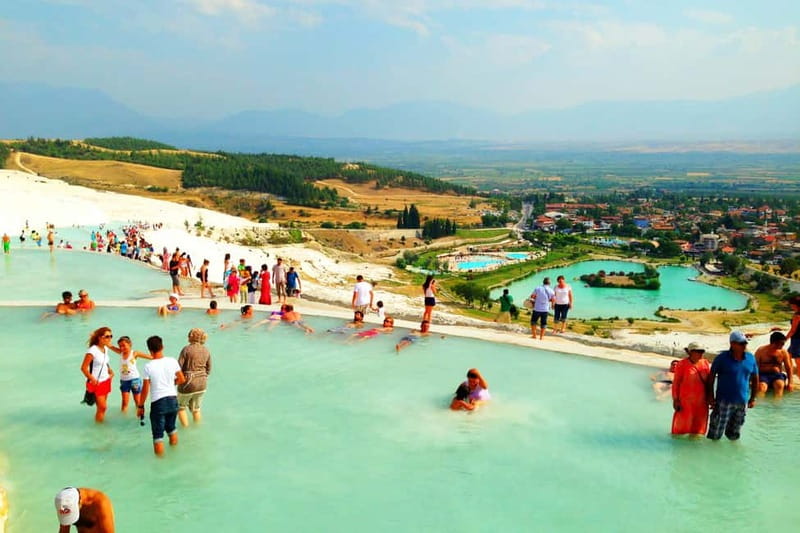
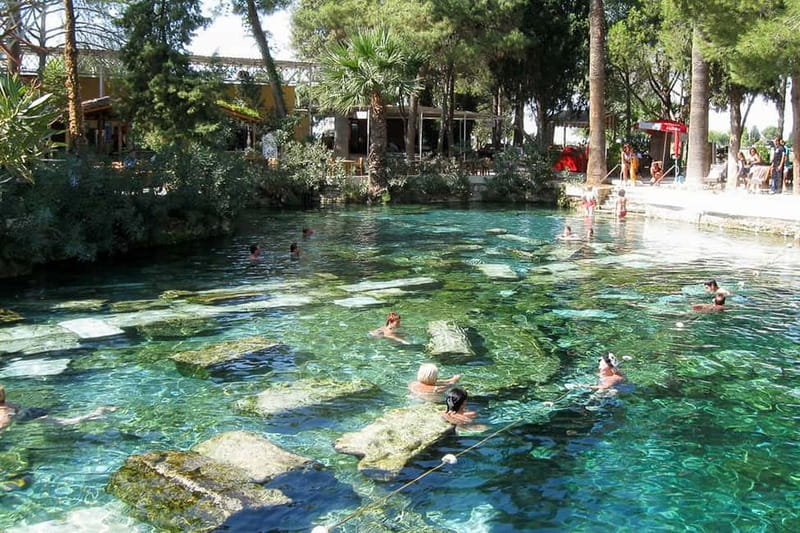
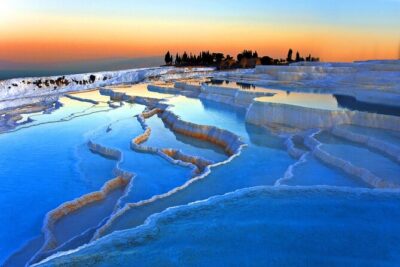
More thermal pools down the Pamukkale hillside:


Pamukkale Cotton Castles: Why the Travertine Terraces Are So Special
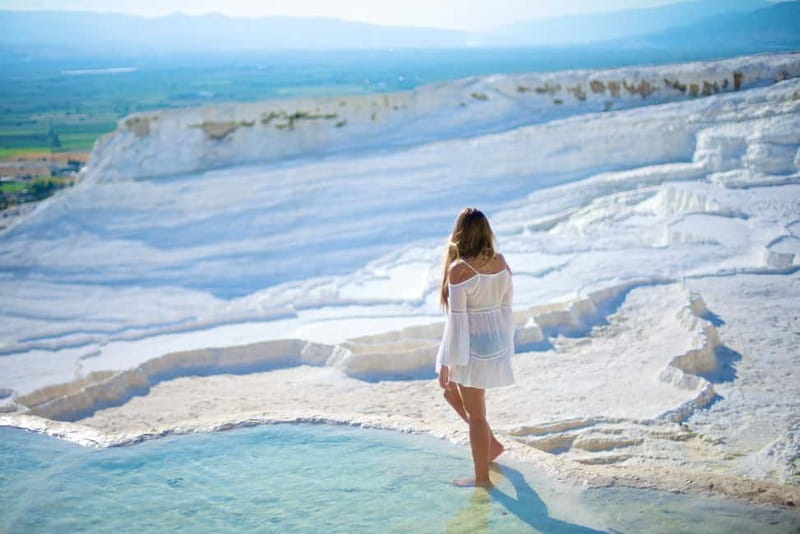
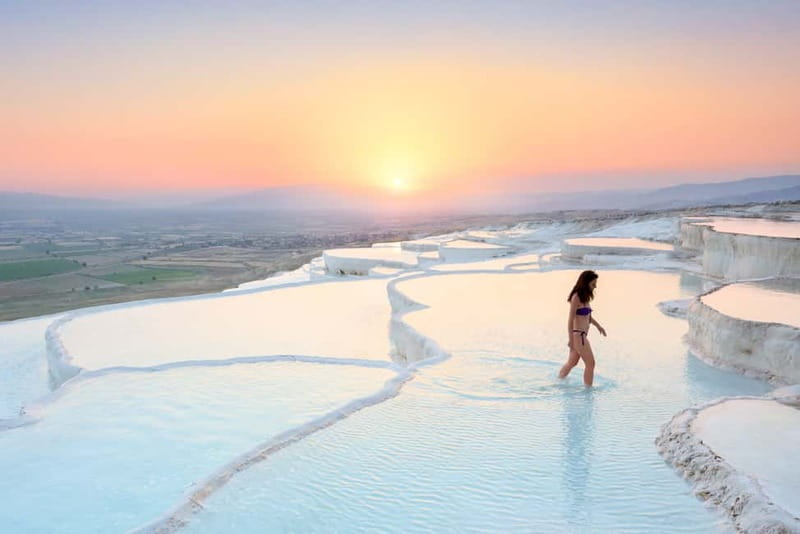
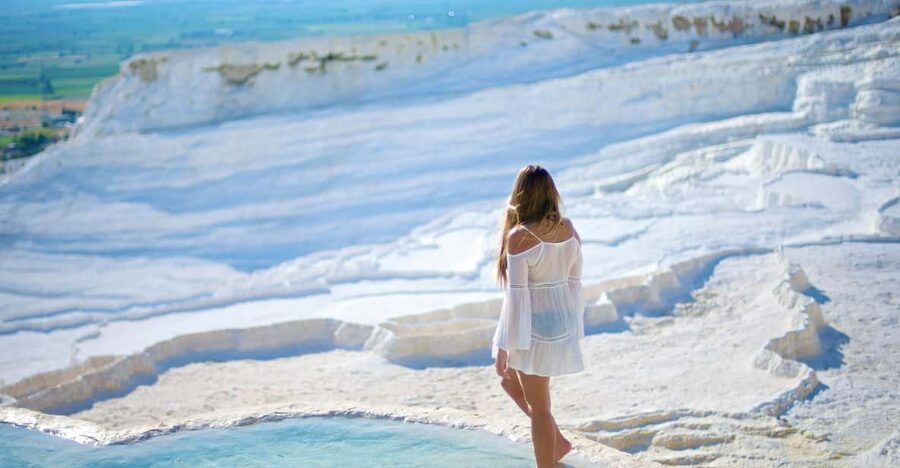
Pamukkale is famous for a reason. The “cotton castles” look soft and unreal from a distance, but up close they’re all about hard science made visible: water rich in carbonate minerals flows and builds up the famous travertine terraces.
What I like about Pamukkale on this tour is that you’re not only treated to the main areas. You also get views from the opposite side of the valley in the nearby town of Denizli, which helps you understand the scale. From that viewpoint, you can spot how the terraces step down and how the pool areas relate to the broader Pamukkale basin.
At ground level, you’ll see limpid pools, hot springs, and the mineral terraces that create that recognizable white look. It’s also one of those places where footwear and walking choices matter, because you may move along uneven ground and near wet surfaces. Bring flip-flops or water-friendly sandals if you have them, and use your towel from the start, not only at the end.
A small tip that can save you time: the best views usually come from the top areas rather than trying to go way down to the lowest spots. If you’re short on time or energy, spend your energy where the sightlines are strongest.
Hot Springs and the Cleopatra’s Pool Reality Check
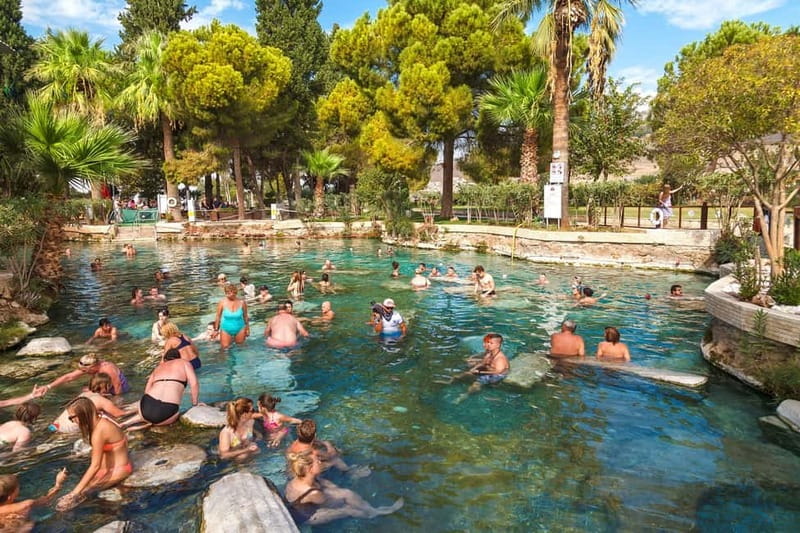
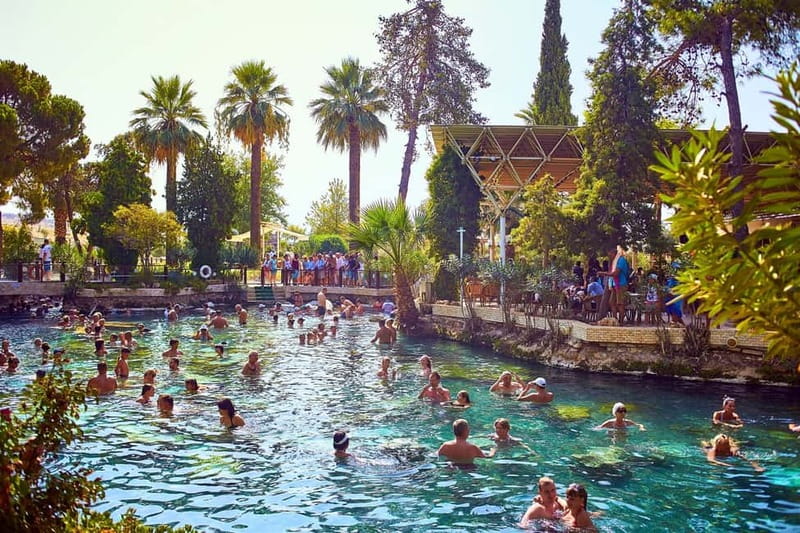
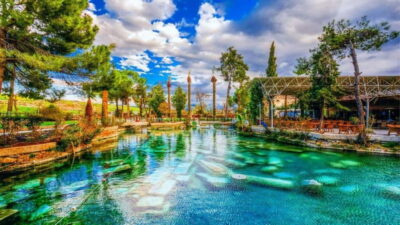
Pamukkale is not just scenery, it’s a hot-springs destination. The tour gives you time around the hot pools and clear-water areas, so you can experience the mood of the place rather than just glance at it.
That said, timing and expectations matter because Cleopatra’s Pool is temporarily closed for renovations. If you were picturing a swim or being able to get right into that classic Cleopatra area, you’ll want to know ahead of time that access is not available at this time. The rest of Pamukkale still remains the main event, so you’re not losing the whole day, but you are trading the Cleopatra moment for extra time in the other pool and terrace areas.
If you bring swimwear and a towel, you’ll still be set up for what is open. Even when the pool area is restricted, the overall Pamukkale experience often feels better when you’re dressed to go with the flow. You can always decide on the spot whether you want to soak briefly or just enjoy the terraces and water in a quieter way.
Hierapolis Ruins: Amphitheater Views and the Turkish Bath Museum
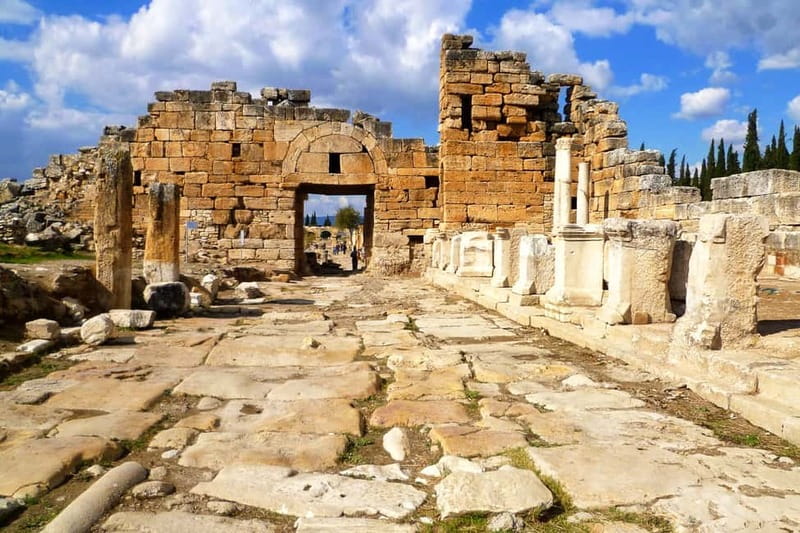
Hierapolis sits right on top of the Pamukkale terraces, and that layering is part of the fascination. You move from mineral-water wonder into a Greek-Roman city that was built here and then shaped over centuries.
At Hierapolis, the Roman amphitheater is the star you’ll want to find early. Even if you’re not a theater-history person, the amphitheater’s sheer size helps you imagine how public life worked in the Roman world. The good strategy is to take a few minutes to find your orientation point, then slowly look across the seating and stage area so your brain can do the time-travel math.
Another highlight is the former Turkish Bath, now turned into an archaeological museum. It’s a smart stop because it’s not just stone rubble. It’s a place that still tells you how people used to use built spaces, long before modern tourism turned the area into an open-air site.
This is also where you’ll learn why the Romans cared about this place. It wasn’t random. Pamukkale’s location and water made it meaningful, and the city grew around those advantages.
If you can, aim to give Hierapolis the time it deserves. One good rule of thumb is about 90 to 120 minutes for a thoughtful visit to the amphitheater area and museum zones, especially if you like reading plaques and listening to your guide’s explanations.
What Fethiye regulars wave over next
- Istanbul: Private Turkish Bath, Massage, and Spa in Old City★ 4.6 · 3,225 reviews
- Antalya Pamukkale Hot Springs & Hierapolis Tour With Lunch★ 5.0 · 1,092 reviews
- Antalya: Spa and Skin Care Experience with Massage and Drink★ 4.8 · 628 reviews
Necropolis of Anatolia: Sarcophagi, Including a Marcus Aurelius Name
The Necropolis of Anatolia is where the tour gets quieter and more solemn. Instead of big monuments like the amphitheater, you’re surrounded by sarcophagi and tomb architecture, a landscape of memorials that turns your attention toward mortality and status.
The standout named example here is the sarcophagus of Marcus Aurelius Ammianos. Even if names are not your usual focus, seeing one tied to a recognizable historical figure helps you connect the site to the wider Roman world. It also adds a sense of why these burials were designed the way they were, with attention to prominence and legacy.
This stop can be a great pairing with Hierapolis. After you’ve seen public buildings, you’re then seeing how people planned for private memory. The contrast is part of what makes the day feel complete.
Guided by Yalcin and Friends: How the Liveliest Part of the Day Works
A big reason this tour earns strong scores is the guide energy. Names you may hear in the group include Yalcin or Yelcin, and in some cases guides are described with nicknames like Curly. The theme is consistent: lots of talking that stays focused on what you’re actually looking at.
Here’s the real value for you: a good guide turns the day from sightseeing into understanding. You get live context about the sites, geography, and the way Roman-era life connected to what came before and after. You also get practical guidance on where to stand, what to notice, and how to pace yourself so you don’t rush through the parts that are the payoff.
The guide also helps manage group logistics at big sites, which matters because Pamukkale and Hierapolis can draw massive crowds. This tour includes skip-the-ticket-line handling, which saves time when you want to get moving toward the terraces and ruins zones.
Language coverage is also solid: English and Russian are offered with a live tour guide. If you’re comfortable in either, you’ll get the benefit of explanations in a language you can actually process while standing in the sun.
Lunch, Breaks, and Timing: Making a Long Day Feel Reasonable
Food on long tours is not a small detail. This day includes lunch, and many people report that it’s more than a token meal. In practice, a proper sit-down meal helps you avoid the classic end-of-day slump where you start skipping photos because you’re too tired to care.
There are also breaks during the drive. Some guides use these breaks to reset everyone before arrival, which you’ll feel when the walking starts. One more time-saving detail: you often do not need to stay glued to the group the whole way. The better guides give you enough time to explore key zones on your own after they’ve explained what matters.
One tip based on how the sites work: don’t try to over-maximize the terraces. You don’t need to go to every step and dip down every lower section to understand Pamukkale. The more efficient move is to focus on the areas with the best sightlines and mineral patterns, then spend your remaining energy on Hierapolis and Necropolis.
If it helps your planning, you may see roughly four hours total across Pamukkale and Hierapolis areas, depending on the flow of the day. That’s enough time to do the core stops and still pause for a swim or a slow look, as long as you keep an eye on time and weather.
Also, if you want a souvenir stop, there may be a gemstone factory visit if time permits. If you prefer to keep your day purely sightseeing, treat it as a “maybe” and be okay if it’s skipped. If it happens, you’ll usually have time to browse and decide quickly.
Price and Value: Is $74 Worth It Plus the 30 EUR Tickets?
The listed price is about $74 per person, for a 12-hour day with hotel pickup and drop-off, air-conditioned transportation, a live guide, and lunch. On paper, that can look like a simple number. In real life, value comes from what you avoid.
You avoid the stress of arranging transport between Fethiye and a far-reaching site like Pamukkale and then trying to thread Hierapolis into the same day. You also avoid a lot of on-the-spot decision making, because your guide handles the sequencing and keeps you from missing major components.
The tradeoff is that entrance fees are not included. You should budget an additional 30 EUR for Pamukkale & Hierapolis. Because this is a UNESCO-level draw, those ticket costs can feel like a shock if you’re only thinking about the $74 figure.
Still, when you compare the full package, the money often makes sense. You’re paying for logistics, guided time, and reduced friction. If you’re traveling with limited time in the region, this is often the easiest way to see both Pamukkale and Hierapolis without turning your day into a transportation puzzle.
If you like flexibility, the booking style you’ll encounter here is usually pay later and free cancellation up to 24 hours in advance. That reduces risk if your schedule is still shifting around.
Who Should Book This Tour (and Who Might Skip It)
This tour is a strong fit if you:
- Want a single-day plan that covers both Pamukkale and Hierapolis
- Enjoy history explained clearly, not just seen quickly
- Prefer a group format with a guide who manages pacing and priorities
- Are okay with a long day that includes a serious amount of coach time
It may be less ideal if you:
- Want a slow, unhurried vacation day with minimal driving
- Are specifically focused on Cleopatra’s Pool swimming, because the pool area is closed for renovations right now
- Dislike structured schedules, because you will be moving through set zones with set timing
Also consider your walking stamina. Both Pamukkale’s terraces and Hierapolis’ ruins involve uneven ground and steps. It’s not a “sit and ride” experience, even though the guide will do what they can to keep you comfortable and informed.
Should You Book This Fethiye to Pamukkale and Hierapolis Tour?
If your goal is to tick off Pamukkale Cotton Castles plus Hierapolis ruins in one day, I think this is a solid booking. The biggest strengths are the organized logistics, the included lunch, the comfort of the A/C bus, and the way guides like Yalcin make the history and geography click while you’re standing there.
Just go in with the right expectations. Cleopatra’s Pool is currently closed, so plan to enjoy Pamukkale’s terraces and hot-springs atmosphere without that specific swim moment. Also budget the 30 EUR entrance fees, so you don’t feel surprised when you arrive.
If you want a high-value day with minimal hassle, and you’re fine with a long drive, this tour is the kind of trip that makes your limited time in the region feel worthwhile.
FAQ
How long is the Fethiye to Pamukkale and Hierapolis tour?
The tour lasts 12 hours.
Where do you get picked up?
Hotel pickup in Fethiye is included, with hotel drop-off at the end of the day.
What’s included in the tour price?
Included are hotel pickup and drop-off, transportation by air-conditioned bus, a live guide, and lunch.
Are entrance fees included for Pamukkale and Hierapolis?
No. Entrance fees for Pamukkale & Hierapolis are not included and are listed as 30 EUR.
Is Cleopatra’s Pool available during the tour?
Cleopatra’s Pool is temporarily closed for renovations, and pool access is not available at this time.
Do I need swimwear?
Yes. Swimwear and a towel are recommended since you’ll have time around Pamukkale’s hot springs and pools.
What language is the guide available in?
The live tour guide is available in English and Russian.
Is it a long drive from Fethiye to Pamukkale?
Yes. Fethiye to Pamukkale is around 200 km, so expect a long drive as part of the day.
Newest to reach the Fethiye table
- Oludeniz Paragliding in Fethiye Turkey
★ 5.0 · 20 reviews - Pirate Boat Trip from Oludeniz
★ 4.0 · 21 reviews - 12 Island Boat Trip from Fethiye
★ 4.0 · 22 reviews - Fethiye: Babadag Tandem Paragliding Flight over Oludeniz
★ 4.9 · 22 reviews - Dalyan Day Trip with Mud Bath and Turtle Beach From Fethiye
★ 4.5 · 23 reviews - Horse Riding in Fethiye
★ 4.0 · 23 reviews
Pamukkale & Hierapolis Trips, side by side.
From Antalya/Kemer: Pamukkale & Hierapolis Day Trip w/Meals
Read our review →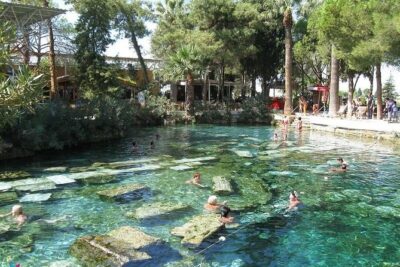
Pamukkale Hierapolis and Cleopatra’s Pool Tour with lunch from Antalya
Read our review →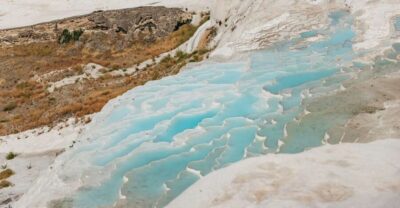
From Antalya/Kemer: Pamukkale and Hierapolis Tour with Lunch
Read our review →
Antalya Pamukkale Hot Springs & Hierapolis Tour With Lunch
Read our review →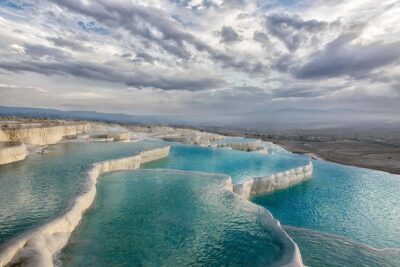

Full-Day Tour of Pamukkale from Antalya with Lunch
Read our review →
Full-Day Tour to Pamukkale From Marmaris w/ Breakfast & Lunch
Read our review →Lists this tour turns up in